Saturday, January 10, 2015

Another Layover in Taiwan

Well as many of you know by now I have moved down to New Zealand! It's been a while since I've posted so just to quickly update, I capped off an Education Degree (specifically teaching high-school-level students) with a final practicum placement in Oliver, BC just before Xmas. It all went well, had a great Xmas with family and friends, then hopped on a Boxing Night Red-Eye across the Pacific. Why NZ? Well there are a lot of good reasons to live in Aotearoa ("The Land of the Long White Cloud") but mainly because my wonderful girlfriend Lisa Jones lives there and is a teacher too! I'll be trying to get some teaching work myself while getting to know her friends and family and probably catching up with a few birds too. I lived in NZ back in 2008 so have a pretty good idea of what I'm getting into. As you'll see from following blog posts, there is still plenty of new and amazing places for me to explore to some great outdoor adventures ahead!

But before you find out what I've been getting up to in NZ, I should first put up a brief summary of my day-long layover in Taiwan. Two years ago on my flight back from Australia to Canada I had a similar layover and a friend-of-a-friend Dustin Wang took me around for some great birding. My China Airlines flight had me stopping over again so I emailed Dustin and he was happy to take me around again. Last time we concentrated on Taiwan endemics that were close enough to Taipei (Taiwan's capital in the north). These birds are mostly in the hills so this time around we decided to bird more around low-lying coastal areas where I had a good chance to pick up a number of lifers since I have never birded Asia apart from a trip to Borneo. Below are some photos and a brief summary of the day.

A distant shot of downtown Taipei as we whizzed north up the expressway. In the middle is Taiwan 101, the 6th-highest building in the world. At the time of its completion in 2004 it was the tallest structure in the world at 509m (101 floors), but in 2010 the Burj Khalifa was finished in Dubai with its whopping 828m and 163 floors.
Our first stop of the day was for this juvenile Siberian Crane--a first record for Taiwan! It's been around for a few weeks much to the delight of local birders and has been relatively confiding. With only three or four thousand of these cranes left in the wild, I felt lucky to catch up with this fellow.
Taiwanese birders admiring the crane. This picture also shows the rich and diverse cultivation common in Taiwanese countryside, even in winter. It's very cool to see that even in the downtown core, almost everyone has a garden and is finding ways to grow their own food.
Just before seeing the crane, this immature Brown Shrike became my first official lifer of the day.
Another lifer shrike for the day--this time a Long-tailed Shrike.
Another shot showing the crane and lowland Taiwanese landscape.
Unfortunately we did not have enough time to stop for too long as our two main birding locations were far apart and the weather was rather abrasive with wind and rain. Still, I was quite charmed by the dramatic coastline scenery of NE Taiwan. For an island-nation of around 24 million, it's amazing how much green space Taiwan enjoys. What also surprised me was that there are no gulls in Taiwan! There are fishing ports everywhere and it seems like a relatively temperate climate but there are only a few places where gulls might occasionally turn up. Even terns seem scarce. Will have to look into this.
One of my most wanted world birds--Eurasian Hoopoe!
Common Sandpipers were one of the few birds to be found along the rough outer coast; bobbing away like their North American cousins.

After missing out on several White Wagtails in BC this year, it was satisfying to see a few here in Taiwan while eating lunch. There were also several Eastern Yellow Wagtails around though I did not manage a photo of them.
And here is the most colourful winter-plumaged wagtail--the unfortunately named "Grey Wagtail."
Dusky Thrush is one of the more common Turdus thrushes in the lowlands of Taiwan in winter. This was a lifer and one I hope to see in Canada one day! Other Turdus lifers in the same area were Pale Thrush (one of the most common birds here it seems--sort of the American Robin of rural Taiwan), and Brown-headed Thrush though I didn't get photos.
Another nice Asian equivalent of a North American regular. This Green Sandpiper in basic plumage--not too dissimilar in looks or call from Solitary Sandpiper but in flight their bright white upper tail feathers are conspicuous.
Here's a crisp-looking adult Brown Shrike.
What I believe to be a Common Snipe (split from Wilson's a decade or so back). Let me know if you think otherwise.
Looks like a Little Ringed Plover to me.
More Taiwanese greenery, not far from one of the larger cities in the world. A Crested Serpent Eagle was whistling a way as I took this photo.
Had to include at least one temple shot. Each Chinese and Taiwanese temple has unique ornaments, with the "Dragon Wall" (gray engravings in front) acting as a sort of signature of the artist. At least that's what I gathered.
I think that building in the distance is the same temple pictured above. We had a nice long walk in this area birding local forests, plantations, and back alleys. It seems that "private property" is a lot more relaxed here as no one seemed to care that we were walking through their chicken coop or up their driveway. Taiwanese people have to be some of the friendliest in the world. Also on this river was my lifer Eastern Spot-billed Duck. Apparently the sedentary Taiwanese population is a future split candidate.
This is where a lot of the shorebirds and wagtails were hanging out. Even though this is all private land, birders were walking all over these fields. It so happens that I visited on a national bird count day. I understand that many birding groups here have adopted the American "Christmas Bird Count" tradition and have set up circles throughout the country. Not sure if we found anything too exciting for their count but I was happy with a few more lifers including Yellow-browed Warbler, Japanese Bush-Warbler, Black-faced Bunting, and Daurian Redstart.
At a nearby sportsfield we scanned for thrushes, wagtails, and pipits. I did not have any fieldguides with me but IDed this as a Richard's Pipit (Dustin knew the Taiwanese name but not the common name) as it has very little streaking on the chest and flanks. If you think this is another pipit please comment below.
Another lifer--Naumann's Thrush
Another Dusky Thrush shot for good measure
I thought this Eurasian Kestrel might be a lifer but it turns out I saw a few in Greece 11 years go. Still a beauty.
I think this was the only slam-dunk endemic bird I saw on this trip, though it's arguably the best-looking one anyway. Unfortunately this Taiwan Blue Magpie was scarfing down some bread when I snapped this pic.
The last photo I took that day was of this confiding Black Kite.
All in all I think we had around 55 species for the day. Not a bad way to spend a Christmas Bird Count, but I was certainly itching to get on that plane to Lisa and New Zealand. As expected, Dustin was a tremendous host and treated me to some great local cuisine including a luffa stew. Yes LUFFA is a food too! Check it out. After 2 layovers in Taiwan I'm up to 85 species for the country. Will have to return some day for a proper visit. 

Up next: NEW ZEALAND!

Friday, September 19, 2014

Sep 13/14 Tofino Pelagic Adventures

Dawn rises over Tofino Inlet. Saturday, Sep 13. (Photo: RC)

As usual it has taken me a while to get around to making this post. Life has kept me busy! The following is a brief account of two pelagic trips I organized off Tofino, BC on September 13th and 14th, 2014. In recent years, WildResearch has done a fabulous job running annual boat trips out of Ucluelet (the community south of Tofino) which has made the fabulous seabirds of the west coast much more accessible to British Columbian birders and outsiders alike. Unlike the coastal states south of here, to get to the outer coast, Canadians much take a ferry to Nanaimo, then drive over two mountain passes before reaching the small port towns of Ucluelet and Tofino. This makes any pelagic an expensive undertaking, which can be made extremely frustrating when you travel all that way only to have your boat trip cancelled due to foul weather. The big MV Francis Barkley that WR eliminates some of this risk as it is much more capable of handling swell that the little whale-watching boats that most people had to use previous to 2011. This year WR only ran a spring trip so several people called me up earlier this year asking if I could put together a small venture in the fall. A rough date was settled and in the end we decided to try for two days in a row to get as much out of the weekend as possible. Gilbert Bouchard was one of the main catalysts for the trip as he came all the way here from Quebec!

As always, when running small pelagic trips I go with the Tofino Whale Center. They're rates are reasonable but most of all they're skippers know what they're doing and have many years of experience watching and working with local marine wildlife. Prices can fluctuate but chartering one of their Boston Whalers is usually around $1200 for 6 hours, so with 12 people you can bring it down close to a reasonable $100 each.

We were a little nervous showing up bright and early on Saturday. The rumour was that there were no fish out there, and thus--no birds. Locals were remarking on the lack of whales... the lack of everything close to shore. From chatting with Paul Lehman and others it seems the NE Pacific has been inundated with unusually warm waters which has resulted in some conspicuous shifts of bird life (an indicator of other things as well). Species like Ashy Storm-Petrel and Guadalupe Murrelets--normally associated with Mexican waters--have been showing up off the coast of Oregon and Washington recently, while huge Sunfish and Yellow-fin Tuna have been seen off Alaska in areas they have never been recorded. So what would this mean for us? Hardly any birds? Maybe a rarity from the south? At the very least we realized we would probably have to head out to the continental shelf or further to find anything.

Sure enough there was very little inshore. In fact I don't think we saw a single Sooty Shearwater within the first 10 km offshore. Even Glaucous-winged Gull numbers were dramatically and noticeably low on the rocky islets near Cleland Island. Still, we did note a few nice birds as we made our way out, including a group of 65 BLACK OYSTERCATCHERS on one small islet and a WANDERING TATTLER not far from Tofino. A few WESTERN GULLS were also around. Below are a few photo-highlights from the two boat trips, with COMPLETE LIST TOTALS AT THE BOTTOM.
With a sigh of relief, we spotted our first Black-footed Albatross as we neared the continental shelf. A single fishing boat has attracted around 18 of these gentle giants from Hawaii and as always I savoured the call, "Albatrosssss!" (Photo credit: Dave Fraser)
Mid-September is a great time to see Buller's Shearwaters off BC. These NZ endemics are possible the most beautiful shearwater when seen in flight, but it's also pretty cool to observe them resting casually on the water. As the wind and swell was fairly light on both days, many of the shearwaters we encountered were "chilling" in mixed flocks, allowing for careful approach. (Photo: Dave Fraser)
Of the regular tubenose species encountered in BC waters, the Flesh-footed Shearwater is often one of the most coveted. I think in around 10 Tofino pelagic trips that I have participated in, this is only the second time I have had one. This bird was picked out among 10 other Pink-footed Shearwaters resting on the water. (Photo: Yousif Attia)
These guys might just be my favourite species encountered regularly in BC pelagic waters. Small and pudgy balls of feathers with a stomach packed with fish, these Cassin's Auklets are absolutely comical to watch as they attempt to "fly" away from the boat, skipping off each tiny wave; their bellies dragging as their tiny wings try desperately to lift their body weight. I assume many are molting which may explain their poor flying abilities at this time of year. We encountered many of them on both days out beyond the shelf in Clayoquot Canyon. (Photo: Dave Fraser)
For many on board, mammals stole the show on both days. I'm used to seeing plenty of Humpback spouts on boat-trips off the west coast but we really were spoiled by close encounters with these amazing beauties, including a group of around 8 that surrounded our boat and casually fed around us as other seabirds like the Pink-footed Shearwater pictured to the right, went after schools of fish pushed to the surface. This year has been a struggle for the whale-watching industry in Tofino apparently so we felt a bit spoiled with our show 60 km offshore. I guess it pays to be a crazy birdwatcher!
The highlight for our skipper John Fordde was undoubtedly this FIN WHALE, which we encountered on the Sunday. This was a lifer mammal for him, and one that obviously is not regular off this part of the island (at least not this close to shore). At one point the whale lay completely upside-down under our boat, explosing its long white belly for nearly a minute of eerie silence as we sat wondering what its next move would be! I've seen Fins off the east coast but that was 15 years ago so this was fantastic--and it's the second largest animal in the world! (Photo: Dave Fraser)
This photo captures just how calm the seas were on the weekend. Here, part of the group photograph a Tufted Puffin as it paddles casually away. (Photo: Russell Cannings)
A huge highlight for me, was seeing this massive ELEPHANT SEAL! I've wanted to see one in BC for a long time and seeing this big boy was a real treat. This appears to be a young male but from what I could see I would estimate he was well over 1500 lbs! (Photo: Dave Fraser)
Elephant Seal from the forehead angle. Just bouncing up and down like a cork. If a cork was made of blubber and thick skin.
DAY TOTALS: Only counting species seen more than ~2km offshore out to a maximum of 67km offshore.

Saturday, September 13th

Surf Scoter--8

Loon sp.--4

Black-footed Albatross--26

Northern Fulmar--31

Pink-footed Shearwater--230

Buller's Shearwater--20

Sooty- Shearwater--84

Sanderling--1

South Polar Skua--3

Pomarine Jaeger--2

Parasitic Jaeger--3

Long-tailed Jaeger--1

Jaeger sp.--5

Common Murre--51

*Probable Scripps's/Guadalupe Murrelet--1+ (Only seen by 2 people. Read comments here)

Cassin's Auklet--80

Rhinoceros Auklet--33

Tufted Puffin--7

Black-legged Kittiwake--2

Sabine's Gull--2

California Gull--217

Herring Gull--5

Glaucous-winged Gull--1

Gull sp.--20

Sunday, September 14th


Common Loon--2

Loon sp.--4

Black-footed Albatross--33

Northern Fulmar--54

Pink-footed Shearwater--160

Flesh-footed Shearwater--1

Buller's Shearwater--33

Sooty Shearwater--78 (Very low count--last year on the same date I had 6000+)

Fork-tailed Storm-Petrel--2

Phalarope sp.--3

South Polar Skua--3

Parasitic Jaeger--3

Common Murre--60

Pigeon Guillemot--2

Marbled Murrelet--2

Cassin's Auklet--51

Rhinoceros Aucklet--42

Tufted Puffin--11

Sabine's Gull--3

California Gull--190

Herring Gull--9

Glaucous-winged Gull--22

Mammal List (Combined):

Fin Whale
Humpback Whale
Orca
Harbour Porpoise
Northern Elephant Seal
Harbour Seal
Steller's Sea Lion
California Sea Lion
Northern Fur Seal
Sea Otter
Mink

Friday, June 13, 2014

"Western Teenagers" Big Weekend Report!

First off--If anyone is still periodically checking this blog to see if something new has been posted--my sincere apologies! I haven't updated since October after being fairly active previously. Things have been busy but I know I really should get on top of this. You can expect a final Borneo post and a "Winter 13/14" summary, as well as an upcoming Arizona summary.

Now... who are the "Western Teenagers" and where did they come from???

First some background:

Traditionally I form a team of 3-5 for the Okanagan Big Day Challenge--where we usually bike and walk around the South Okanagan in an attempt to see as many species as possible in one day and raise funds for bird conservation via the Baillie Birdathon. 

One of the fondest memories I have of birding was back when I was 11, and my Dad and others colluded to bring together a few young people to form a "big day" team. In those days most big days were driven and of course young teens can't drive so generous birders like Don Wilson and Dave Fraser would drive myself and a few other young birders (usually Ryan Tomlinson of Kelowna and Gabe David of Victoria) around the South Okanagan. This was the first time I had birded with similarly keen or even keener birders my age, and it greatly aided to stimulate my growth as a birder and naturalist, even though this was a once-a-year event. Our drivers also served as birding-gurus in those early years as I can still remember Don teaching us what a Townsend's Solitaire call-note sounded like, or how to separate Hammond's from Dusky Flycatcher by primary-projection. Really, it was just a lot of fun.


I'm 27 now and continue to try and network and get out birding with others my age or younger but I notice that it's still fairly rare for teen birders to have similarly aged and keen companions, even in Vancouver where there are several of them--the connections just haven't been made in many cases. Young Naturalist Clubs are fantastic in offering a variety of outings for young people interested in nature, but for the kids that are REALLY keen and are already becoming as skilled as some of their adult mentors, I think there is room for more enrichment, and more specifically--opportunities to network with other birders/naturalists their age. The adolescent period is a time when many young birders decide to continue birding or become busy with other things. I think making connections with similarly-minded peers can help a lot in keeping that interest in nature strong, which usually leads to broader interests in biology and conservation issues as a whole---which is obviously something that is very important in this day and age--particularly for the next generation.


As a small step in this direction, and also to fulfill my own selfish desires to have a fun weekend with young birders, I started sending out emails to the young people I knew of around BC, to see if they would be interested in heading to the south Okanagan for the May long weekend for several days of birding with other young people. Of course their parents' would have to OKAY it as well. Things started off small with the 4 or 5 keen birders I was already well acquainted with. As I looked into this however, I discovered more and more young teens in various communities who were immensely keen about this idea and in the end I had 11 birders between the ages of 9 and 17 take part in the weekend's events including 3 girls (a rare demographic as many of you know)! Most hail from the Vancouver area but there are also kids from Victoria, the Sunshine Coast, Kamloops, and Kelowna. There were a few others that wanted to come but couldn't get there for various logistical reasons.


So here they are! Day 1 (Saturday), birding the famous Rd 22 area north of Osoyoos. From left to right: Liron from Vancouver, Logan from Kelowna, Khalid from Burnaby, Josh from Vancouver, Isaac from Kamloops, Timmy from Vancouver, Tim's dad Jeff, Jordyn from Penticton, Isaac's dad Darryl, Rebecca from Victoria, Rebecca's dad Warren, Kai from Egmont, Jordyn's mom Colleen, and Rick from Pender Harbour (Sunshine Coast). Hopefully I got/spelled those right? Anyway, it was awesome to see everyone hitting it off and having a great time birding the Okanagan. Lifers were being oggled left right and centre and it was a heck of a lot of fun.
The group is beaming after a close encounter with a male Black-chinned Hummingbird at Inkaneep Provincial Park in Oliver.
Sunday was BIG DAY day! Unfortunately I had to fly to Arizona for a tour in the mid-morning but I was at least able to join the "Western Teenagers" for some night owling where we heard Western Screech, Northern Saw-Whet, Great Horned, and Flammulated Owls. The team started the morning waaay up in the hills above Okanagan Falls then worked their way down to Vaseux Lake. The afternoon was spent around White Lake. This photo was taken at the start of the Dutton Creek Rd in the "Venner Larches" area up in the hills. This is where I had to depart but it sounds like the boys did really well! 133 species and enough to win the coveted Flammulated Owl award for most species on the Okanagan Big Day Challenge. By all accounts it was a fun day for the kids and their noble drivers!
Here George Clulow presents Logan, Khalid, and Liron with the BCFO 2014 Young Birders Awards!
Part of the "Western Teenagers" and their award for top species total!
In addition to being a fun weekend of birding and getting to meet like-minded young people, this birdathon also sought to raise money for bird conservation efforts as well as the local Vaseux Lake Bird Observatory. With several donations still being process, the Western Teenagers have thus far combined to raise over $1,800!

There is still time to donate, so consider pledging to one of the members at this LINK.

A big thank you again to all of the parents for allowing and encouraging their kids to take part in this fun event, and special thanks to those parents that offered to drive!

Looking forward to making this an annual event!

Wednesday, October 9, 2013

Wow it's a Blog Update!

Weellllll, it's been a while since I've updated. To the regular readers I apologize! I'll still try and get some more Borneo pics up at some point as there are still some good stories to convey. A little hard to get motivated this far removed. Oh well. Since then I returned to Canada, led a birding tour to Ontario, worked in Revelstoke and the North Rockies all summer, spent time with my lovely lady Lisa, and came out with a new BOOK!

In September I moved to Nanaimo where I have embarked on a different kind of journey--my quest to become a high-school teacher (at Vancouver Island University--formerly Malaspina College). So far Island--life has been great, with some fun new birding areas to patrol, decent weather, and a fantastic cohort of fellow wannabe-teachers. My practicum is in Port Alberni--a place I have only ever "passed through." I see this as a wonderful chance to explore yet another corner of BC and experience a host of challenges that might face a new teacher in a new town.

There is only one other person from my cohort that is assigned to the high-school in Port Alberni--Gerry Budda, an awesome dude originally from the Island but has lived in East Asia for the last ~10 years. Nice to have someone to share the ups and downs of lesson-planning, classroom management, and all that stuff with! Thanks to the kindness of a fellow classmate (Jen Fink), we have been set-up with a billet-type situation at her parents place on the shores of Sproat Lake--about a 15 minutes drive east of Port Alberni. On our second day, Jen's father Hardy offered to take us out on the lake for a cruise in his boat. Below are a few highlights:

The Hawaii Mars (front), and Phillipine Mars (Blue in rear)--Only 7 of these were built for the transport of goods during the WWII era. They were the largest float-planes every built by the allies. In 1959 the Mars planes were scrapped but a Canadian Forestry company bought these two and converted them to waterbombers. The scoops on these babies can take on 30 tons of water in 22 seconds. Today, only the Hawaii Mars sees active duty but probably not for much longer. The Phillipine Mars is set to be sold to an American Aviation museum and as you can see it has been re-painted in it's original "NAVY Blue." For most of their waterbombing career, they have been stationed here at Sproat Lake--right across from Hardy & Cynthia's place--where we're staying! 
Our trusty skipper out on Sproat Lake--Hardy is the former coach of the Canadian National Gymnastics Team. He still coached internationally and the day before this photo was taken he was "on business" in Antwerp.
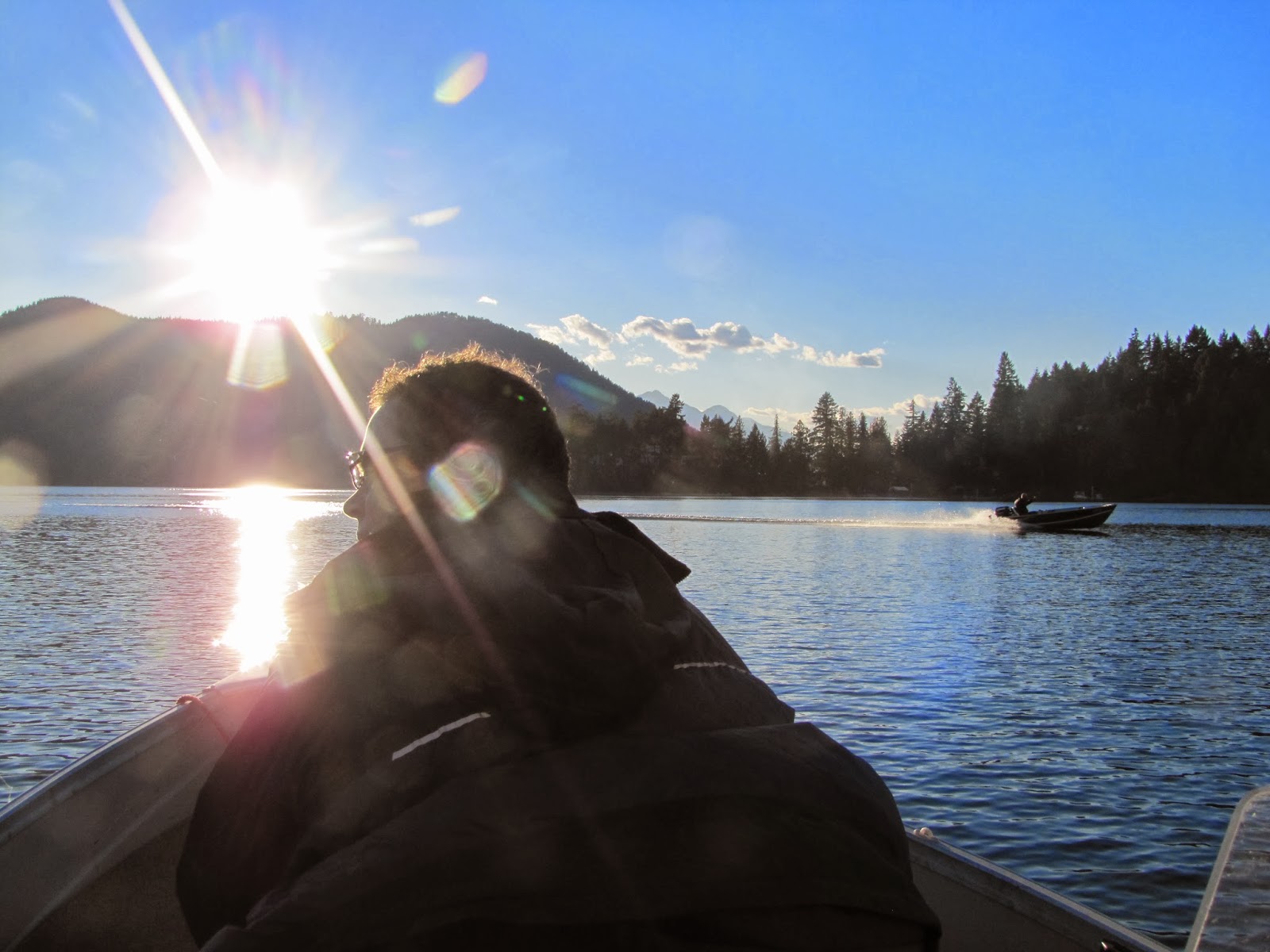
Gerry Budda (Mr. Budda is a fantastic teacher name!) taking in the top-notch weather on a lazy afternoon.
Here's where we're staying--the Fink residence. Not bad!
More posts to come--hopefully in less than a couple months this time!

Monday, July 1, 2013

Borneo Blog: Sepilok

And here's a brief telling of my time in Sepilok; a remnant tract of primary forest surrounded by thousands of hectares of palm-oil plantations. Indeed, as you drive east from KK, there is little else but palm-oil. Malaysia produces most of the world's palm-oil, and Sabah produces much of Malaysia's stock (and this is growing everyday, as many residents tell me the government's figures are huge underestimates). While economic development in this part of the world, is encouraging, it is extremely sad to see Borneo's famous jungles devastated and fragmented in this manner. It does seem that local and national bodies have realized the potential negative impact this can have on tourism (which is largely of the ECO variety here in Borneo), as well as the dangers of planting a monoculture. The oil-palm is an African species, and grows well in SE Asia because of the lack of natural pests etc. One day however, if an outbreak of disease occurred, it could potentially lay waste to the entire industry, much like the pine beetle in BC.

SO anyway, Sepilok is a small village on the main highway, but it's one of the easiest ways to access some of the remaining native forest in Sabah, plus it's the most famous place in the world to see Orangutans!

And here's one now. The Sepilok Orangutan sanctuary is home to many "rescued" animals, that had to be rehabilitated for life in the wild. Apparently there are truly wild apes in the area as well, and this could be one (according to one of the interpreters).
As you cans see however, these places can be a bit of a zoo (of people), and I must admit that the experience was not very enjoyable. Luckily I was able to marvel at one of the ginger-haired apes earlier in the morning, before the crowds, as it casually swung from tree to tree, like a lazy Tarzan.
I didn't realize that my camera was all fogged up from the humidity. Anyway, here we see one of the park rangers feeding some of the resident Orangs (or "Mias") some bananas.
Pig-tailed Macaques also like to join in. This guy was taking a break on one of the climbing ropes.
On our first visit to Sepilok, we stayed in some hostel rooms in a jungle resort. Since our room lacked A/C, we pretty much hung by the pool all day. In the mornings I went birding. The roads are lined with plenty of mistletoe-infested trees so I added several flowerpeckers to the lifelist, some sunbirds, and my first spiderhunters! If you're wondering why I took a picture of a hole in the ground, that's because this is a HOODED PITTA nest! (4 nestlings).
Not too far from the orangutan reserve is the "Rainforest Discovery Centre." As a relatively newbie to rainforest canopy walkways, I was definitely in birder-heaven. I sneaked in early in the morning and saw loads of lifers including several Malkoha species (colourful cuckoos), a few new bulbuls, and my first piculet (mini-woodpecker)--a Rufous Piculet. The stand-out highlight for me was just one of those AMAZING birding moments: There I was, admiring a pair of BORNEAN BRISTLEHEADS (why didn't I have my camera)... these birds are rare and crazy-looking in their own right. The fact that I was watching them at eye-level (from a canopy tower) was special enough. But then I heard a loud scream and squawk, that echoed through the forest, and from behind my head flew 3 RHINOCEROS HORNBILLS in all their glory. Double-lifer action and epic birds at that!!! Cherry on top was a RACKET-TAILED DRONGO that thought he'd add to the splendor of the situation by dive-bombing the male hornbill. 3 of the world's coolest birds at one time!
Here's Jess with a large tree.
And here's Jess with a giant isopod. Everything's big in Borneo!
The ever-curious Pig-tailed Macaque
That's right; another brilliant bird photo from RC. This is a cool bird though--my first RED-BEARDED BEE-EATERS!
Thanks to the canopy walkway, I get to look DOWN on this male DIARD'S TROGON
This was a nice one to find, as they can be tough to see in Borneo. This is the RUFOUS-COLLARED KINGFISHER. A forest-specialist that mostly feeds on lizards. 
After missing them in Australia, it was also neat to be in a place where LARGE-TAILED NIGHTJARS are extremely abundant to the point where they keep you up at night... TOK-TOK-TOK-TOK-TOK! It never stops!

Sunday, June 23, 2013

Borneo Blog: Mount Kinabalu


Okay, major apologies for taking this long to post. In fact it's been so long that I can't muster the energy to do this trip justice. In an earlier post I introduced my journey to Borneo. Well the following couple slabs will give you a slight taste of what I did there (Feb/Mar 2013). The rest you'll have to hear anecdotally over the next few decades!
After meeting up with my friends in Kota Kinabalu (the capital of Malaysian Borneo's northern state of Sabah), our first priority was to head over to the island's most famous peak--Mt Kinabalu! At just over 4,000m, this is the 20th-highest mountain in the world. To climb it you usually have to book well in advance plus shell out some serious $ (for a poor person like me), so we were happy to spend out time hiking around the bottom. At this time of year there is a lot of rain, so I was lucky to catch the mountain on a clear morning before the clouds rolled in. Birding here can be frustrating due to the low-light conditions in the forest and my lack of song/call knowledge of Asian species. Still, I was able to rack up a lot of nice birds including a variety of Asian flycatchers such as Mugimaki, Pygmy Blue, Little Pied, and the possibly locally rare find--Ferruginous. Also bagged a few endemics here like Whitehead's Trogon, Golden-naped Barbet, Bornean Treepie, Bornean Whistling-Thrush, Bornean Flowerpecker... etc etc. Saw my first wagtail ever--a rather yellow "Grey Wagtail," plus a variety of other Asian things I had always drooled over in the fieldguide and now finally got to see.
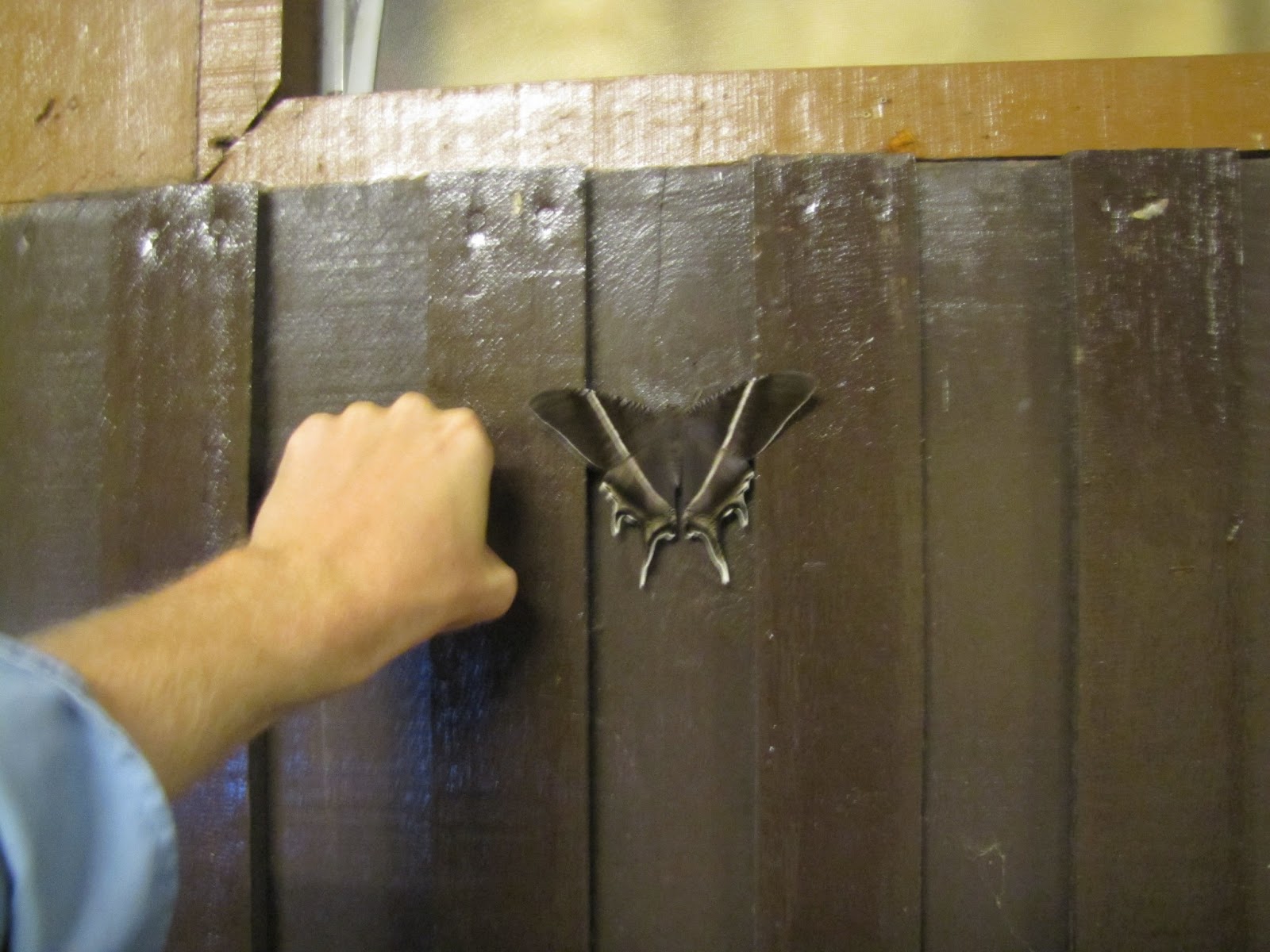
Borneo has a lot more that birds to see. At first you might not notice any living things in this photo... but there are actually two! A moth that looks like a leaf... and.
This guy--some sort of awesome gecko, with lichen-styled skin.
Yet another crazy-awesome leaf-mimicking moth (all these were on the side of our hostel)
Big ol' butterfly that looks kinda moth-ish
The Swede soaks in the Bornean rainforest, while a couple leeches soak up something else in his socks (Tip: Don't stand in tropical creeks for too long)