October 12th
Today I bussed/trained over to Midlands Station SE of Perth
where I met up with Liz Fox of BirdLife Australia. Despite my evident lack of
Australian birding experience, Liz is graciously taking me out into the Mallee bushlands,
about 500 km east of Perth, where I’ll be helping with bird surveys in a small corner of what is known as the
“Great Western Woodlands.” This massive area contains some good chunks of
untouched eucalypt woodland and Mallee heath, which has essentially been
destroyed or fragmented by farming activities in the “Wheat Belt” closer to
Perth. This area has apparently never been properly surveyed for birds, so
Liz’s aim is to find out what’s there (bird-wise and habitat-wise), and compare
this to some of the remnant patches of original ‘bush’ closer to the coast
whose bird populations are better known. There is also a hope of creating a
natural habitat corridor from the area she’ll be surveying to the good stuff
left near the coast. In addition to the surveys, we’ll also be meeting up with
a few local naturalists to try and wrestle up some more volunteers for the
project.
So basically we’re going camping/birding for a week, out in
the bush, and I am about to have what some might call, “a good time.”
 |
| Dusky Woody |
As we drove east out of the greater Perth area, heading for
the mining boom-city of Kalgoorlie, the first trip bird was a lovely NANKEEN
KESTREL. A bird I should have had by now, and of course once I had one, they
became one of the most common birds along the highway. A mixed flock of
woodswallows included my first DUSKY WOODSWALLOW then I spotted a flock of
COCKATIELS ripping by as we passed a grain silo. Just east of Southern Cross, a
gorgeous REGENT PARROT blitzed across the highway in front of us—a beautiful
bird, but the best was yet to come.
Liz spotted a whitish parrot well up the highway and
speculated that it might be a corella. But as we drew nearer we both realized
what it really was—“MAJOR MITCHELL’S!!!!!” we both shouted. This charismatic
cockatoo is probably one of Australia’s most recognizable birds yet few
Australians (let alone tourists) see them since they stick to the arid interior
and never stray to the coasts. This had been one of my biggest targets for my
Aussie trip but I had’t expected to get it this week since we were a fair bit
south of their usual range. Oh well… I’ll take it! This was also Liz’s
second-ever sighting of a Pinko in the wild
 |
| Taken from the car, Mitchie showin off his crown plumes |
 |
| Browsing |
(*Pinko is not actually a known
colloquial term for Major Mitchell’s Cockatoo but Aussies do like to add O’s to
things, plus the species is known to hang out in ‘social’ groups… so here’s
hoping it catches on).
We rolled into the outskirts of Kalgoorlie in the early
evening and decided to suss out a good camping spot before heading into town
for dinner. “Lake Douglas” had an appealing ring to it since there is very
little in the way of water in this part of the world, and so birds flock to
these watering holes like birds to a watering hole.
And here she is, serene and glorious.
 |
| "Lake" Douglas |
While technically this is probably more of a glorified
puddle, birds were indeed on scene. A pair of PINK-EARED DUCKS came in to spend
the night, and a lone HOARY-HEADED GREBE dove for who knows what. The main
action was in the adjacent shrubs where Liz called out lifer honeyeaters for me
one by one—SPINEY-CHEEKED; WHITE-EARED, YELLOW-PLUMED… oh and there’s an INLAND
THORNBILL. Next up was the smallest thornbill of them all—a group of WEEBILLS
whistling merrily as they danced through the eucalypts. Somewhere a CRESTED
BELLBIRD sang his puzzling whistled/gonging song (at the same time and out of
sync), and finally, an elegant WHITE-BACKED SWALLOW was the last addition of
the day.
 |
| Cropped photo of some cool ducks (Note the pink ears) |
As things got dark we headed into Kalgoorlie—perhaps the
Australian version of Sudbury, Ontario (sorry Sudbury)—famous for its
impressively high “strip-club per capita” ratio, as well as the largest
open-pit mine in the world (as I am told... more on that tomorrow). Liz wasn’t
too familiar with the cuisine of Kalgoorlie so we stopped in at a place
labelled “Food Court” figuring there might be a decent selection. Sure enough,
there was a food court inside, but not your typical Subway/Burger King/Greek/Sizzling
Rice/ Frozen Yogurt bar-type affair. Inside were six booths, marked by flickering
neon signs: “Mexican,” “Italian,” “Asian,” “Greek,” “Fish & Chips,” and one
creatively titled, “Desserts.” Sounds
fairly typical, but it appeared that all of these shops were operated by one
Singaporese family who didn’t seem overly motivated to bother manning all of
the booths, limiting our choices to Italian, Asian, and Greek. I tried first
for Greek but was completely ignored by the attendee so I moved on to
“Asian”—probably the safest choice anyway.
I just realized that I am describing supper in great
detail—this could make for a long blog post, best to call it a night…
Not so fast!
 |
| King Brown Snake: 7th deadliest in the world. This bloke slithered past me as I set up the tent in the dark |
October 13th
 |
| Aussie Ringneck |
First bird of the morning was a calling SPOTTED NIGHTJAR
around 4am. As the sun broke over the scenic open-pit mine on the eastern
horizon, I took a stroll through the arid woodlands near our camp hoping for
some more lifers. Yep, got some! A flock of 15 PURPLE-CROWNED LORIKEETS
rocketed past overhead then a pair of BROWN-HEADED HONEYEATERS popped in for a
quick view. A family of BLUE-BREASTED FAIRY-WRENS were my first of many on the
trip, then I finally got a decent photo of this common parrot—the (Western)
AUSTRALIAN RINGNECK—after some careful stalking near the ‘lake.’
At the respectable hour of 8 o’clock we made our rendez-vous
with a pleasant group of outdoor enthusiasts who were interested in Liz’s
project. The participants ranged from a professional reptile biologist to a
twelve-year-old girl with an endearing obsession of quartz. Out of the fifteen
or so people, only a few knew some of the local birds, so in addition to
explaining the project, Liz and I split up into two teams and headed out into
Karlkurla Park (Pronounced, ‘gull-gurl-la’ which is the Aboriginal name for the
native ‘silky pear’—this is also where Kalgoorlie derives it’s name) to demonstrate
the practise of two-hectare bird surveys.
It was a very hot morning so birds were a little hard to
come by, but luckily even the common birds are lifers for me! This
YELLOW-THROATED MINER is certainly one of the more conspicuous residents of the
inland forests around here, although not much of a yellow throat on this one.
We also had a few non-bird highlights including this CRESTED
BICYCLE DRAGON
Around ten we retreated to a small plant nursery where some
locals had organized a lovely “morning tea”—something that I had certainly
heard about but never observed while living in New Zealand… the more meals the
merrier!
 |
| Black and red earth, typical of the Kalgoorlie area. Almost looks like asphalt... more on that later |
After tea, Liz and I bid our farewells to the group and
headed to the main event (wink)—the SUPER PIT!
 |
Looking down into the SUPER PIT. This mine produces 28 tonnes of gold each year, or enough to adorn
20+ circa. '89 hip hop artists, with a little left over |
 |
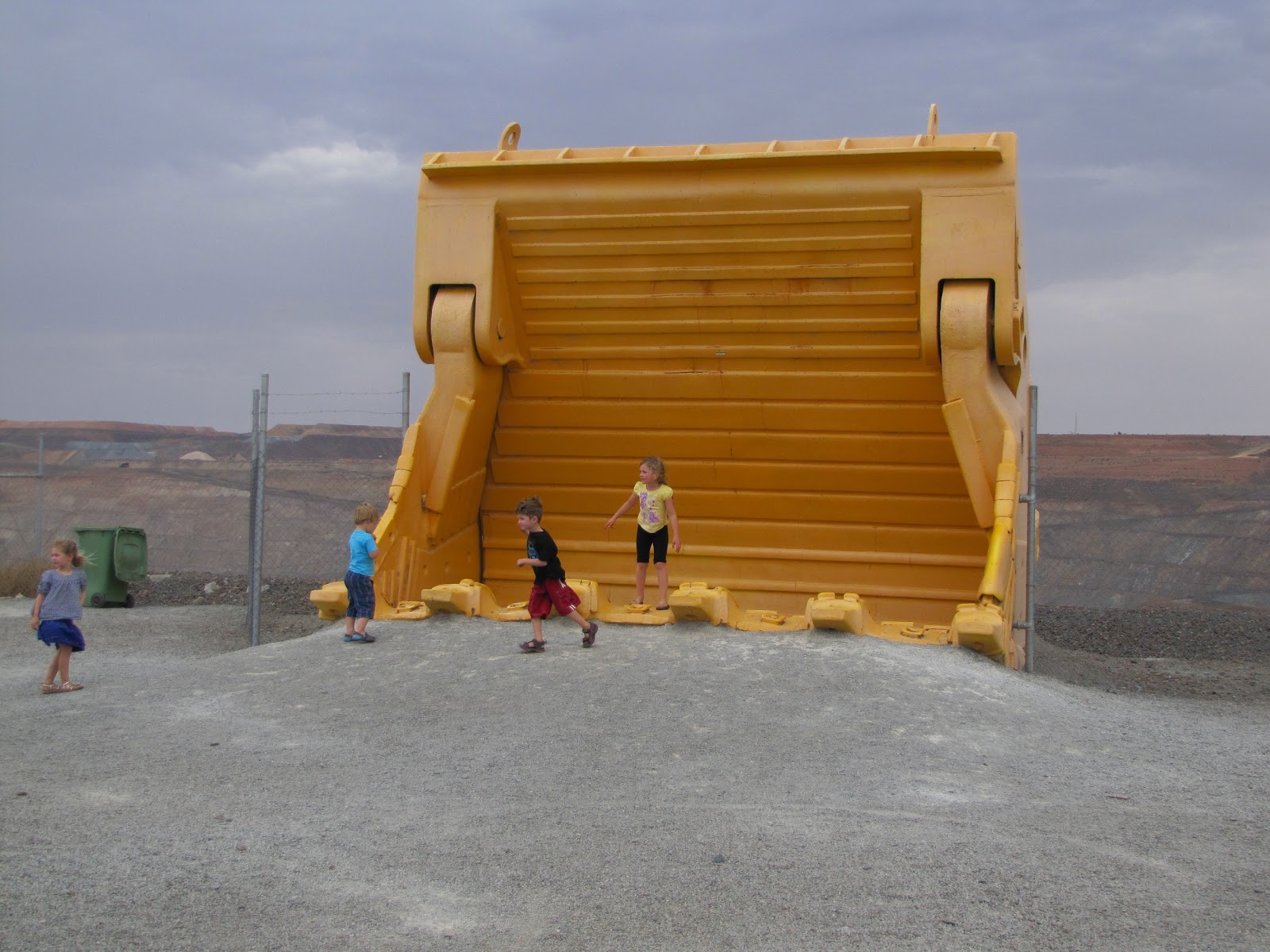
| Kids playing in the "Super Bucket" which is designed to handle 60 tonnes of ore. Good ol' Mine Tourism! |
 |
| Adult Sharpie--Good bird away from the coast |
From there we turned south, bound for the coastal city of
Esperance. Not too far south from Kalgoorlie we spotted a small alkaline lake
that actually had water in it so naturally as any self-respecting Aussie birder
should do—we stopped to take a look. On “Silver Lake,” a distant MUSK DUCK was
nice then I noticed an adult SHARP-TAILED SANDPIPER in close, as well as a
small group of WHITE-FRONTED CHATS (Nice to finally get good looks at this cute
buzzy bird after so many fly-overs). We also had brief looks at a nervous
BLACK-TAILED NATIVE-HEN.
Then as we returned to the truck we were accosted by a
grumpy local—perhaps for good reason—Somehow in our attempt to reach what we
thought was the Silver Lake parking lot, we had inadvertently driven past
several barricades and parked smack-dab in the middle of an active driving
range (we’re talking golf for the non-sports people out there). We were
informed that any damage to the vehicle would be at our own expense, and if we
wanted to get out we had to drive around the back of a sand-trap (the whole
thing’s a bloody sand-trap) near the adjacent first hole. Luckily for Liz’s
rental bond, we made it out unscathed and got back on the road to Esperance.
 |
| Here we are parked in the middle of the driving range; I swear the whole forest looks like a parking lot! |
As we neared Esperance (after passing “Shark Lake”—not sure
if I’ve ever seen those two words together before), we made sure to stop in at
the local golf course following a tip from Nigel…
 |
| The supposedly endangered Cape Barren Goose. I think we saw 14 browsing here |
 |
| If you ever want to whack balls at an endangered goose, here is your chance! |
In addition to the geese there were plenty of other
waterbirds around including my long-awaited lifer WOOD SANDPIPER. Finally
redemption after missing the BC bird in 2010.
Next we pulled into our camp site for the night—a large
caravan park, located conveniently right on the beach, in Esperance. Lifers
here included COMMON BRONZEWING, WESTERN WATTLEBIRD, and down on the beach was
my first PACIFIC GULL for life, although ‘only’ a juvenile.
 |
| Juvie Pacific Gull beside (to scale) Norfolk Pine. At 3.5m tall, it's the biggest seagull of them all |
That evening we ate out at the posh and appropriately named
“Loose Goose” restaurant—our final supper in civilization since we would be
heading into the bush for a stretch of five days, beginning tomorrow.
October 14th
The morning was a breezy but sunny affair this morning.
Esperance is truly a beautiful seashore town, with white sand beaches,
picturesque rocky islets, and azure-blue water. In some ways the town reminds
me of a bigger wide-open version of Kaikoura in New Zealand. I had a bit of
time to kill before meeting up with the local Esperance birding group for an
outing nearby, so I walked out on the old tanker jetty near the caravan park. A
couple more juvenile PACIFIC GULLS cruised past, while WILLIE WAGTAILS strutted
their stuff along the beach and NEW HOLLAND HONEYEATERS fed fledglings in the
bushes near the base of the jetty. Once
I got out to the tip, I scanned a small offshore wharf (that used to be
connected to the jetty back in the day before it fell apart) and noted PIED,
LITTLE PIED, and my first BLACK-FACED CORMORANTS. Well offshore I could see
some dark shearwaters arcing on the wind, but they were too far off to say for
sure.
 |
| #scenic |
When I returned to the beachfront I met up with Liz and we
drove out to a headland north of town which provides a good view of the Cape Barren
Geese breeding islands, and there’s a nice little trail one can do to view the
coast to the northwest while picking up a few bush birds like (western)
WHITE-BROWED SCRUBWREN, SHINING BRONZE-CUCKOO, and high numbers of SILVEREYE
and NEW HOLLAND HONEYEATERS. Down on the shoreline Liz spotted a SOOTY
OYSTERCATCHER, and I noted some decidedly distant adult PACIFIC GULLS… need
that bird mate!
We still had about half an hour before our meeting time with
the birders so Liz and I headed to a
small harbour on the other side of town. Not much around but that didn’t matter
since a local fisherman had attracted a small gang of SILVER GULLS, and one
lone big ol’ pristinely adult PACIFIC GULL!
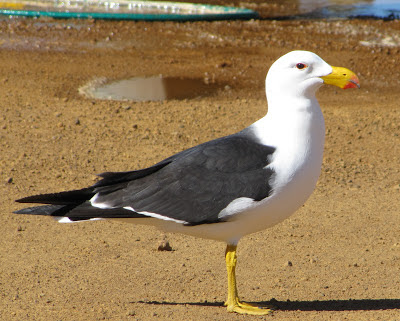 |
| As Christopher Stephens put it, these gulls are truly "Bad to the Bill" |
With that, we headed back to the caravan park where we met
up with Mike and Ellen Gibbs who took us out to a lovely area called Niranda
Springs. Here we met up with the rest of the local birding club who were on
their monthly bird outing. This was fortunate timing for Liz, since this was a
convenient and well-timed way to promote the volunteer woodland surveys and for
me tool since we were birding a great area of mixed habitats with a free
sausage cook-up at the end!
Although it was turning out to be a rather blustery day, it
didn’t take long for my first trip bird. And these were big ones—two nervous-looking
EMUS foraging in a sheep paddock as we approached the local property owner who
had graciously offered up his slice of paradise for the bird outing. Once the
group was assembled and introductions had taken place, we loaded into the
four-wheel drives and headed down through another paddock to a largish shallow
lake. Here we scoped hundreds of GREY and CHESTNUT TEAL, as well as many BLACK
SWANS and PACIFIC BLACKDUCKS. For me the highlight was seeing several (albeit
distant) roosting RED-NECKED AVOCETS in amongst some BLACK-WINGED STILTS.
After morning tea, we checked another corner of the lake
where we had close looks at a few more shorebirds including RED-NECKED STINTS,
SHARP-TAILED SANDPIPERS, and another much anticipated Eurasian wader—3 COMMON
GREENSHANKS.
Next up was lunch—a fantastic home-made sausage cook-off in
a nice little glen on the other side of the property. On the drive there we
stopped at a small dam that had three YELLOW-BILLED SPOONBILLS as well as a
variety of other common stuff. Once in the more treed and wind-protected (great
feature on a day like today) lunch-spot, we were finally able to pad our
passerine day list which included my lifer RESTLESS FLYCATCHER, a few
WHITE-FRONTED, and (Western) WHITE-NAPED HONEYEATERS, as well as a WILLIE
WAGTAIL pair who were building a nest right beside the road.
After savouring a wonderful potluck lunch provided by the
members of the club, Liz and I had to bid our farewells as we needed to get up
into the Great Western Woodlands to set up camp before dark. Mike and Ellen
drove us back into Esperance and we were once again on the road.
 |
| 3 of the cups |
After testing out a few dead-end tracks we finally found our
way into a slightly remote and very cool little camping spot known as “The Cups”—named
for the natural water-pools found in this clearing, surrounded by thick Mallee
scrub. This water-source proved to be an effective attracted to local birds, so
we sat down nearby to watch the show prior to setting up our tents.
BROWN-HEADED and PURPLE-GAPED HONEYEATERS seemed the most common, but I also
scored my first RED-CAPPED ROBIN (a brilliant male) and TAWNY-CROWNED
HONEYEATER of the trip.
 |
| Male Red-capped Robin |
 |
| Nice comparison of the two bronzewing species |
Later in the evening, three bronzewings came in to drink and
they turned out to be male and female COMMON BRONZEWINGS with a lone BRUSH
BRONZEWING. I went for a short walk as daylight faded, and managed my lifer
WESTERN YELLOW ROBIN, then much later while watering a tree in the wee hours I
heard the whiney calls of an AUSTRALIAN OWLET-NIGHTJAR.
But I shouldn’t forget this cool amphibian…
 |
| One of many Spotted-thighed Frogs found at the Cups. Imagine the distant sound of a dirt-biker changing gears, followed by a loud satisfting "WOBBIT" |
October 15th
 |
| Peak Charles--somewhere up there is a Wedge-tailed Eagle |
Today was our first full-on day of point count surveys in
the bush, and Peak Charles National Park is roughly where we were. The actual ‘Peak
Charles’ from which the park gets its name, is an ancient outcropping of granite about 650m tall, which in this country is massive. We could easily see Charlie for about 100 km in any direction.
 |
Typical-looking track that we surveyed along. This is Mallee Heathland folks---
--Home of 1 billion+ White-fronted Honeyeaters |
We hadn’t even made it to the park boundary however, when
one of the most exciting birds an Aussie can hope to whiff decided to put in a
brief but hugely appreciated appearance. We were driving along a well
maintained gravel road (quite a luxury in this corner of the state), when a Neophema parrot ripped across about ten
meters in front of us. The combination of bright yellow underparts, blue face, lime-green
back and tail, and electric-blue outer flight feathers pointed to one bird. “SCARLET-CHESTED
PARROT!?!?!?!” Liz exclaimed, as we screeched to a halt. I thought it might have
gone down into some thick Mallee scrub so we searched the area but couldn't re-find it. Although I was vaguely aware that this is very much on the “Wanted
List” when it comes to Australian avifauna, it wasn’t until I cracked some
fieldguides and chatted with Nigel, that we were extremely fortunate even to
get this brief glimpse. Scarlet-chests are a little-known nomadic-type that
seems to like outback country hundreds of miles from civilization. There are a
few “regular” spots to check for them in Western Australia, but to put it in a
western Canada context—if you lived in Vancouver (i.e. Perth; the SW is where
practically everyone lives in the state anyway), you would need to drive out to
Medicine Hat, except that half the trip would be on gravel roads in the middle
of nowhere and it’s 40 degrees Celsius outside. And now that I’ve provided you
with some very detailed and extremely accurate and enlightening natural history
on the species… we can move on.
The Scarlet-chest was great, but then again everything is
great for me at the moment. It wasn’t too long before my first SOUTHERN
SCRUB-ROBIN hopped into view; then I was chasing a couple singing (Western) RUFOUS
FIELDWRENS around over morning tea.
 |
| Southern Scrub-Robin (15 seconds earlier there was a pair of Shy Heathwrens on this stump!) |
Okay maybe not
EVERYTHING was great. There was ONE THING that was decidedly NOT great. A very
small thing—yes—but there are a lot of them out here! I am speaking of course
of the Australian Fly.
“Flies are of course
always irksome, but the Australian variety distinguishes itself with its very
particular persistence. If an Australian fly wants to be up your nose or in
your ear, there is no discouraging him. Flick at him as you will and each time
he will jump out of range and come straight back. It is simply not possible to
deter him. Somewhere on an exposed portion of your body is a spot, about the
size of a shirt button, that the fly wants to lick and tickle and turn delirious
circles upon. It isn’t simply their persistence, but the things they go for. An
Australian fly will try to suck the moisture off your eyeball. He will, if not
constantly turned back, go into parts of your ears that a Q-tip can only dream
about. He will happily die for the glory of taking a tiny dump on your tongue.
Get thirty or forty of them dancing around you in the same way and madness will
shortly follow.
And so I proceeded
into the park, lost inside my own little buzzing cloud of woe, waving my head
in an increasingly hopeless and desultory manner—it is called the bush salute—blowing
constantly out of my mouth and nose, shaking my head in a kind of furious
dementia, occasionally slapping myself with startling violence on the cheek and
forehead. Eventually, as the flies knew all along, I gave up and they fell upon
me as on a corpse…”
----Bill Bryson from
“In a Sunburned Country”
And so as we proceeded into Peak Charles National Park, it
began to dawn on me that this would be my life for the next few days—from 9 o’clock
in the morning to 6 o’clock in the evening. From working in the Canadian
wilderness, I’m fairly used to having lots of bugs around, but it’s hard to
deal with creatures that are actually TRYING to get into your eyes and mouth…
it made eating a sandwich a very maddening activity. It also seemed that I was
about ten times more attractive to flies than Liz. Every time I looked over it
seemed like she only had two or three around her.
Yet another fantastic week, and once again I owe a lot to a
few awesome people, especially Liz Fox this time around. Can’t wait ‘til next
week’s Western Ground Parrot surveys near Esperance! Until then I’ll just be
relaxing, drinking out of Steins, dabbling in the Indian Ocean, gawking at
Terek Sandpipers, and trying to find a “Turtle Frog.” If you don’t know what
that is—GOOGLE IT NOOOOWWWW!!!
Until next time,
Russell C.H. Cannings






.JPG)
.JPG)


